How Big is the UNIVERSE?
 |
| The Milky Way galaxy. (source) |
.jpg) |
| The Moon (Credit: Getty images) |


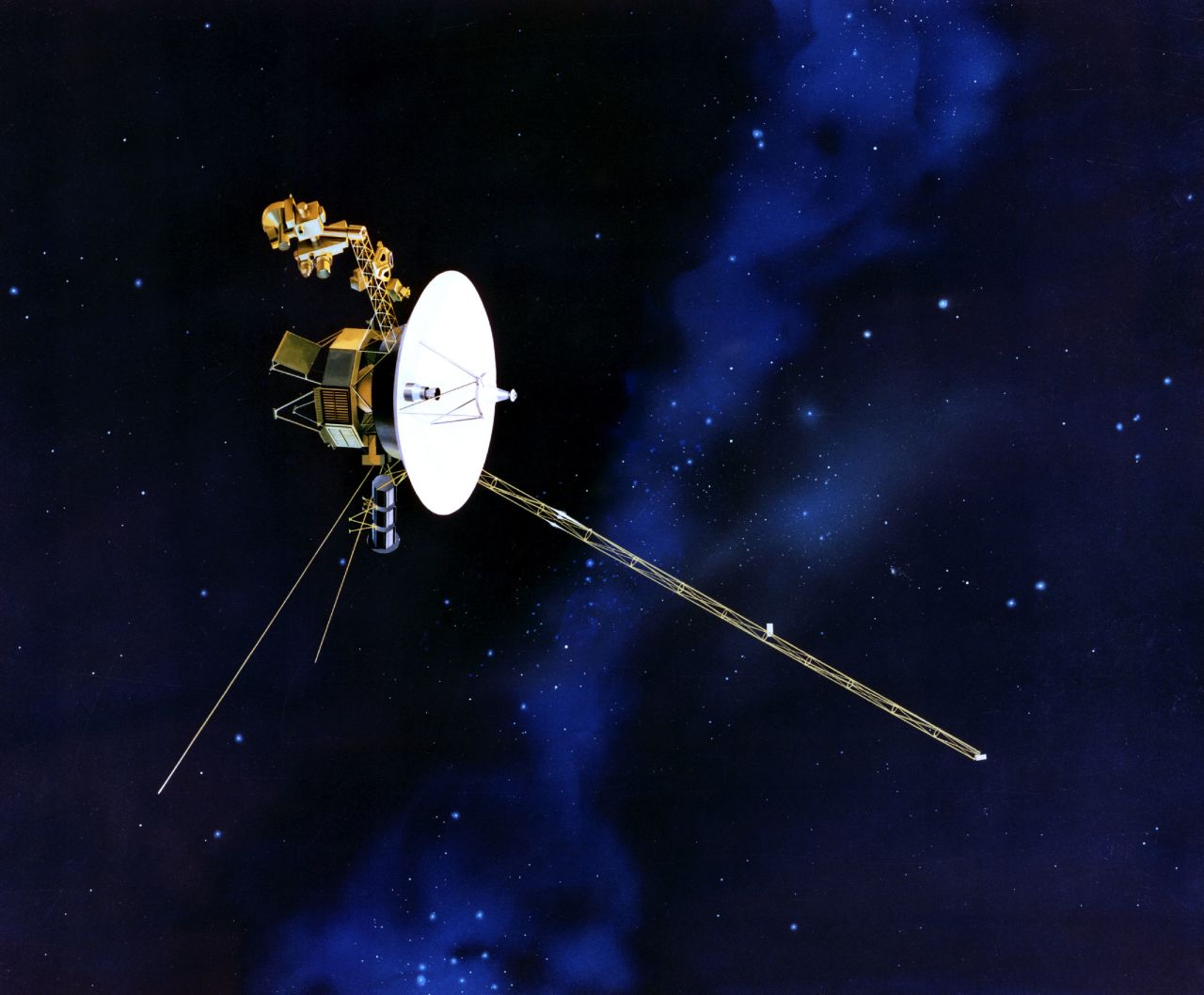
Although it may not seem like much at first, but in my opinion, this is the finest photograph ever captured in the entire history of humanity. Earth is this small pale blue dot in the distance. Every person who has ever lived, every person we know, every possession we have, and everything in the history of our species has always been right here, on a tiny dot amidst this huge cosmos. Here is earth and us. The current speed of Voyager 1 is 17 km/s but even with this speed, it would not be able to break the reach of our solar system in another 30,000 years.
| "The Milky Way" from end to end (Credit: NASA) |
After we leave the solar system, we reach our neighbourhood in the interstellar nebula. Here, light-year units are used to measure distance (9.461 trillion kilometres). The closest star to our Sun, Proxima Centauri is 4.24 light years away. Meaning, if we can somehow travel with the speed of light we would still need 4.24 earth years to reach there. Further zooming out allows us to glimpse the entire Milky Way Galaxy. The galaxy is 105,000 light-years across and contains between 100-500 billion stars and even more planets. Zooming out even further we arrive at our local group of Galaxy. A collection of 54 different galaxies that Is about 10 million light-years across. When we zoom out even farther, we would find the VIRGO SUPERCLUSTER, which the local group of Galaxy is a tiny segment of. Each dot in the picture corresponds to a galaxy similar to our Milky Way Galaxy. The distance them one side to another is mind-blowing 110 million light-years.
 |
| VIRGO SUPERCLUSTER (source) |
Even the enormous VIRGO SUPERCLUSTER, however, is but a small lobe of the colossal LANIAKEA SUPERCLUSTER. 100,000 galaxies are contained within this gigantic structure. From one side to the other, the diameter is about 520 million light-years.
.png) |
| LANEAKEA SUPERCLUSTER (source) |
.png) |
| Observable Universe (source) |
The width of the entire Observable Universe is mind-staggering 93 billion light-years. What is perhaps most astonishing is we have no idea what lies beyond that. To keep in mind, the Observable Universe is all we could currently see. It is absolutely possible that the rest of the universe is vastly larger and more fantastic than we could possibly imagine. We simply do not know what is out there because light from such faraway places has yet to reach earth. Moreover, light from some places may never reach earth. The universe is still expanding and the expansion speed is faster than the speed of light. As such, even if humanity exists for eternity, light from some places in an infinite amount of time would never reach earth. So, as unbelievable as it may sound even the Observable Universe is may but a tiny slice of what is out there. According to the Theory of Cosmic Inflation, at the present day, the whole universe could be 150 sextillions (1021) times larger than the Observable Universe. The universe is so unbelievably vast and we barely know it. However, that also means, there is so much more to discover!
REFERENCE
Wall, M. (2017, January 12). How old is the moon? scientists say they finally know. Space.com.
https://www.space.com/35291-moon-age-pinned-down.html
Mission Status. Jet propulsion laboratory. NASA. https://voyager.jpl.nasa.gov/mission/status/
Stewart, Suzy. The Virgo Supercluster. The Planets. https://theplanets.org/superclusters/the-virgo-supercluster/.
Alan H. Guth & Paul J.Steinhardt.(1984). The Inflationary Universe. Scientific American.




Comments
Post a Comment